
RTA vs. Pre-Assembled Cabinets: What Contractors Need to Know Before Choosing
Most articles comparing RTA and pre-assembled cabinets are written for homeowners deciding between IKEA and a big-box store. If you’re a contractor managing multiple job sites, juggling timelines, and watching your margins, that kind of comparison doesn’t help you much. This guide is written for trade professionals. Here’s what actually matters when you’re making this decision at scale.
First, the Basics
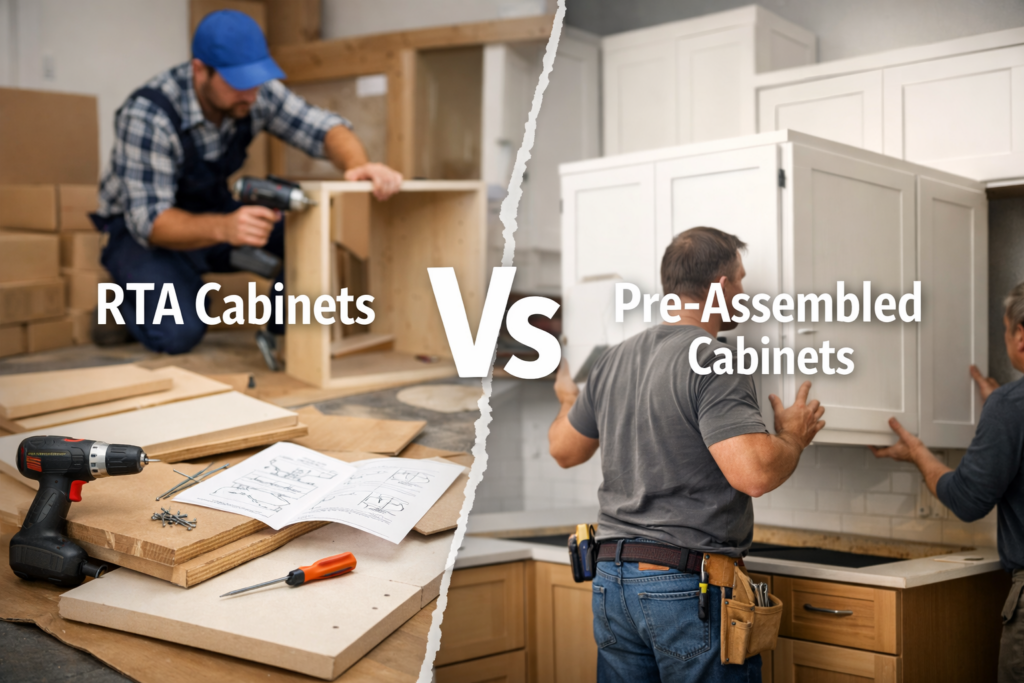
RTA (Ready-to-Assemble) cabinets ship flat-packed in compact boxes. All components — pre-cut panels, hardware, cam locks, brackets — arrive at the job site, and assembly happens on location. For an experienced contractor, each cabinet typically takes 10–20 minutes to assemble.
Pre-assembled cabinets ship fully built, straight from the factory. They arrive ready to install with no on-site assembly required. That’s the simple version. The real decision is more nuanced.
The Real Cost Comparison
The sticker price difference is real: RTA cabinets typically run 20–50% less than equivalent pre-assembled options. For a standard 10×10 kitchen, that translates to roughly $300–$1,000 in savings on materials alone.
But material cost is only part of the equation. Here’s how to think about it more precisely: Labor cost of assembly is the variable that changes everything. If your crew rate is on the lower end, RTA almost always wins on total cost. If you’re billing premium rates and have high-value crews, the calculation shifts — because the labor hours spent assembling cabinets on-site may cost more than the savings on materials.
A useful rule of thumb: if your fully-loaded crew rate is below roughly $125–130/hour, RTA typically generates more profit per kitchen. Above that threshold, the math often favors pre-assembled.
Shipping costs also matter more than most contractors factor in. Because RTA ships flat-packed, freight costs drop by 30–50% compared to assembled units. On a large multi-unit project, this difference is significant — especially if you’re sourcing from a warehouse rather than paying for long-haul shipping on bulky pre-built boxes.
Lead Time and Project Scheduling
This is where RTA has a structural advantage that goes beyond price. Pre-assembled cabinets — especially semi-custom or custom lines — often carry 4–12 week lead times. If your project timeline is tight or your client changes their mind mid-project, that lead time creates real risk.
RTA cabinets from suppliers who maintain warehouse inventory can often be available within days. For contractors managing back-to-back projects or working with short windows between rough-in and install, that speed matters enormously.
The caveat: not all RTA suppliers maintain consistent in-stock inventory. Always confirm availability and restocking cycles before committing to a supplier for an ongoing project pipeline.
Shipping Damage and Quality Control
Pre-assembled cabinets have a well-documented vulnerability: they’re far more likely to arrive damaged. A fully assembled cabinet is a large, awkward object that’s difficult to package securely. Corner damage, door misalignment, and finish scuffs are common complaints.
RTA cabinets, by contrast, ship as individual flat panels that are easier to protect in transit.
Damage rates are typically lower, and if a component does arrive damaged, it’s usually a single panel that can be replaced without scrapping the entire unit.
That said, quality control for RTA depends heavily on the supplier. The key construction details to verify before choosing a line:
- Box material: Plywood construction holds screws better and handles moisture far more effectively than particleboard. This is the single most important quality indicator.
- Joinery: Dovetail drawer construction and solid wood frames outlast cam-lock-only assembly.
- Hardware: Look for brand-name soft-close hinges and drawer slides with published endurance ratings, not generic alternatives.
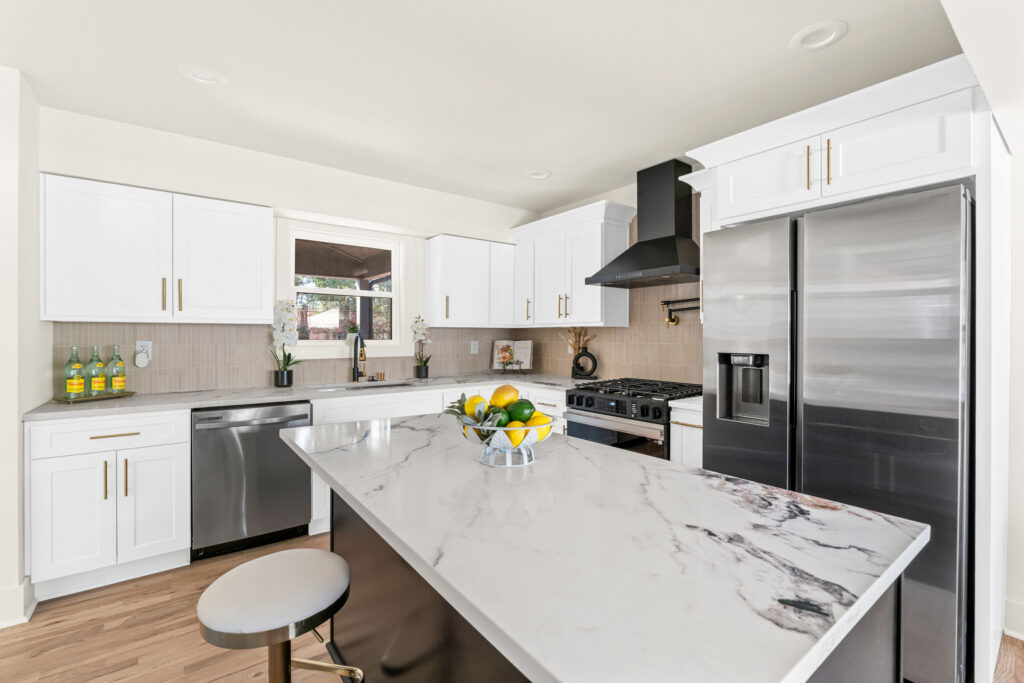
A well-built plywood RTA cabinet, properly assembled, is structurally equal to or stronger than a factory-built unit using hot-melt adhesive. The “RTA is lower quality” perception comes from low-end particleboard products — not from quality RTA lines built on solid construction standards.
When Pre-Assembled Makes More Sense
RTA isn’t always the right call. Here are the situations where pre assembled is worth the premium:
High-end custom remodels where clients are paying for bespoke specifications, unusual configurations, or specialty finishes that RTA lines simply don’t offer.
Tight install windows where there’s genuinely no time for on-site assembly — emergency flips, occupied renovations, or situations where your crew is stretched thin across multiple sites simultaneously.
Crews without assembly experience — if your team hasn’t assembled RTA before, the first few kitchens will take significantly longer than the manufacturer’s estimates. Factor in that learning curve.
Projects requiring heavy customization — lazy Susans, built-in wine storage, blind corner swing-outs, and other specialty configurations are more readily available in pre-assembled lines.
The Multi-Unit Case
For apartment developments, rental property upgrades, house flips, or any project involving multiple identical kitchens, the math shifts heavily toward RTA.
The cost savings compound across units. Shipping efficiency scales up. And assembly becomes faster as your crew develops a rhythm — by unit three or four, experienced crews can assemble a cabinet in well under 15 minutes.
If you’re sourcing cabinets for 10, 20, or 50 units, the per-unit RTA savings add up to real money.
For a 20-unit apartment renovation saving $500 per kitchen, that’s $10,000 back in the project margin.
A Few Practical Tips
Always order extras. Budget for one or two spare cabinet boxes per project. Missing or damaged components happen, and waiting on a warranty replacement can stall your timeline.
Assembly waste is a hidden cost. A full kitchen generates 36–48 flat-pack boxes of cardboard and foam. Factor in $30–50 for disposal and 1–2 hours of crew time for unboxing and sorting.
Test your supplier before committing. Order a sample or a small initial run before sourcing a full project from a new supplier. Consistency across batches — finish color, hardware quality, panel dimensions — matters more on multi-unit projects than anywhere else.
Standardize your process. Develop a consistent assembly method for your crew, ideally with a dedicated assembly station on site. Standardization cuts time, reduces errors, and makes quality control easier to manage.
Neither RTA nor pre-assembled is universally better. The right choice depends on your crew rate, your project type, your timeline, and your client’s expectations.
For most contractors working on residential remodels, multi-unit projects, or spec builds with standard kitchen configurations, quality RTA cabinets offer the better combination of cost, speed, and logistical flexibility — provided you’re sourcing from a supplier with reliable inventory and consistent construction standards.
For high-end custom work where specifications go beyond what standard lines offer, pre-assembled or semi-custom is worth the premium.
Know your project, know your numbers, and choose accordingly.
———————————————————————————————————————————————————————————————————————————————————————–
Lighthouse Cabinetry is a wholesale RTA cabinet supplier based in Peachtree Corners, Georgia, carrying birch hardwood construction lines in White Shaker, Grey Shaker, Blue Shaker, Maple, and more — in stock for fast pickup or nationwide shipping. If you’re evaluating suppliers for an upcoming project, We’re happy to talk.