
Plywood vs. Particleboard Cabinets: What’s Actually Inside Your Cabinets
Most people choose kitchen cabinets based on what they can see — the door style, the finish, the hardware. But the material inside the cabinet box is what determines how long those cabinets actually last. And most homeowners have no idea what they’re getting.
Here’s what the difference actually means, in plain terms
What Is Particleboard?
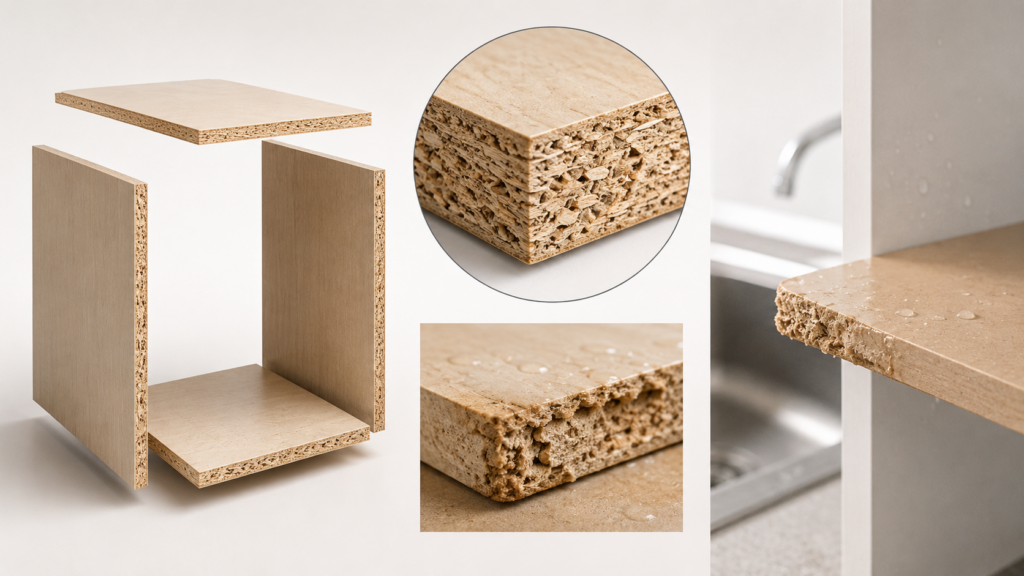
Particleboard is made by compressing wood chips, sawdust, and resin under high heat and pressure into flat sheets. It’s an engineered wood product — not real wood — and it’s used in a significant portion of budget and mid-range cabinets on the market today.
It looks fine when new. The surface is smooth and takes paint or laminate well. The problem is what happens over time, especially in a kitchen environment.
What Is Plywood?
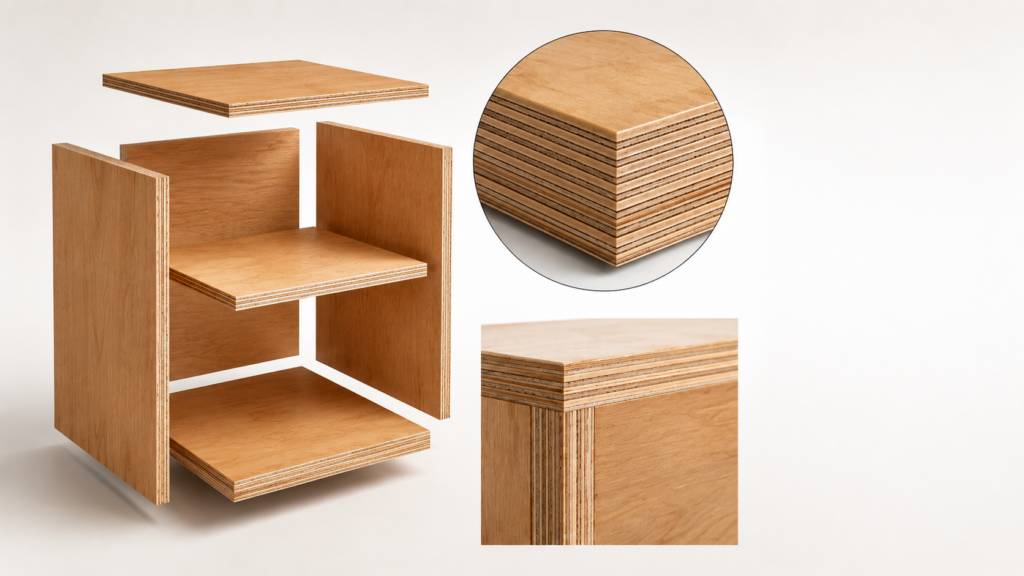
Plywood is made from thin layers of real wood veneer glued together in alternating grain directions. That cross-laminated structure is what gives plywood its strength — each layer reinforces the others, making it resistant to pressure from multiple directions simultaneously.
The more layers and the thicker the plies, the stronger the result. Furniture-grade plywood — the kind used in quality cabinets — is built for long-term structural performance, not just to look good on day one.
The Four Differences That Matter
1. Moisture resistance
Kitchens are wet environments. Steam from cooking, humidity, under-sink leaks, splashes — moisture finds its way into cabinet boxes constantly. Plywood’s layered structure resists water damage and doesn’t swell or warp from brief exposure. Particleboard absorbs moisture easily, and once it does, the damage is irreversible — swelling, bubbling, and peeling laminates that can’t be repaired. Particleboard cabinets under kitchen sinks commonly fail within two to three years due to water exposure.
2. Strength and screw-holding
Plywood holds screws reliably and handles heavy loads without sagging. When you hang a plywood cabinet on a wall, the screws bite into real wood fiber. When you load a plywood shelf with heavy dishes, it stays flat. Particleboard strips screws over time — especially in hinge locations, where repeated opening and closing causes screws to loosen and pull out. Once a particleboard hinge mount fails, there’s no good repair. With plywood, the same location can be redrilled without compromising the structure.
3. Lifespan
Plywood cabinets maintain structural integrity for 20 to 30-plus years with normal use. Particleboard cabinets typically last five to ten years in a high-traffic kitchen before showing significant deterioration. The cost comparison over time makes this concrete: a plywood cabinet system costing $3,000 and lasting 30 years costs $100 per year. A particleboard system costing $1,500 but lasting eight years costs $187.50 per year — nearly double the annual cost, despite the lower sticker price.
4. Installation performance
Plywood holds its dimensions during transport and installation, accepts modifications without splintering, and can be slightly adjusted or redrilled without losing structural integrity. Particleboard requires more careful handling — corners chip easily, and any modification risks damaging the core. For contractors managing multiple installations, these differences add up in time and callbacks.
What About MDF?
MDF (Medium Density Fiberboard) is sometimes presented as a middle-ground option. It’s denser than particleboard and has a smoother surface, making it useful for painted door fronts. But it shares particleboard’s core weakness: it’s vulnerable to moisture, and it doesn’t hold screws as well as plywood. Most contractors specify plywood for cabinet boxes and accept MDF only for decorative elements in dry, low-stress locations.
How to Tell What You’re Getting
Cabinet specifications aren’t always clearly labeled, and marketing language can obscure the real construction. A few things to look for:
Ask directly: “Is the cabinet box plywood or particleboard?” A supplier who uses plywood will tell you confidently. One who doesn’t may give a vague answer about “engineered wood” or redirect to door quality.
Check the weight. Plywood cabinets are noticeably heavier than particleboard cabinets of the same size. If a cabinet feels surprisingly light, that’s usually an indicator.
Look at the exposed edges. Plywood shows layered grain at cut edges. Particleboard shows a compressed, uniform texture without visible layers.
All Lighthouse Cabinetry cabinets are built with plywood box construction and birch hardwood frames — standard, not optional. Browse our full lineup → or contact us to discuss factory-direct wholesale pricing for your next project.